 What Are Swarm Catchers?
If you see a swarm of honey bees and want a responsible beekeeper to come and catch it … we have a list!
The Edmonton & District Beekeepers Association (EDBA) maintains a network of wonderful volunteer beekeepers who provide this free public service. Swarming is a natural part of honey bee reproduction. Our volunteers safely relocate these swarms to suitable apiaries, giving the bees a new home while protecting people and property.
This service supports both the beekeeping community and Alberta’s ecosystem by preserving valuable pollinators.


How to Request a Swarm Catcher
Important: Our volunteers only handle honey bees. Please help us by identifying the insects correctly before calling (see next section).
- Swarms to be removed from Late August to October will not make it through the winter and is discouraged.
- The beekeeper will do their best to save and relocate the hive to a safe location.
- Contact us if you need a secure rescue/isolation yard where beekeepers can bring swarm hives. Due to Mites and diseases/old queens, this yard is used for treatment and isolation of hives brought in before they can be safely be sent to a new home.
It will be helpful if you can safely take photos of the insects, location or swarm.
Be prepared to answer a few quick questions as best you can:
- Identify the insects
- Where is it located? In a tree/on a building/etc.
- How high is the swarm?
- How big does it appear?
- When did it arrive? How long has it been there?
- Do you own the property/house?
If all goes well, the swarm can sometimes be taken away in less than an hour (no promises — weather, location, and bee behavior play a role).
Identify Before You Call
Honey Bees vs. Bumble Bees vs. Wasps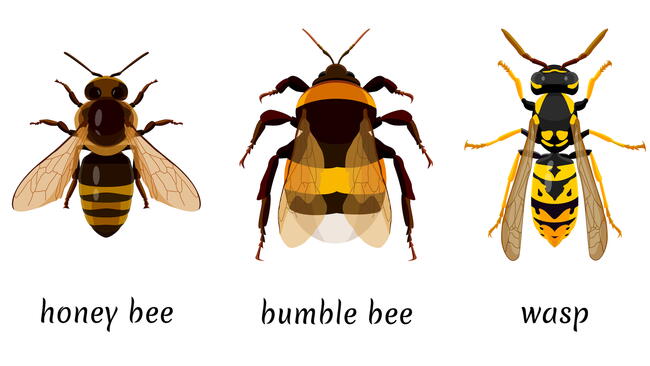
It’s easy to confuse these insects, but proper identification helps us provide the right assistance. Swarm catchers only relocate honey bees (Apis mellifera). Wasps are typically considered pests and should be handled by professional pest control.
Here’s how to tell them apart:
- Honey Bees: Medium-sized (about ½ inch), golden-brown with dark bands, moderately hairy bodies and legs. They often form large, calm clusters (hundreds or thousands) hanging from branches, structures, or entering a cavity. Gentle when swarming; focused on finding a new home.
- Bumble Bees: Larger, rounder, and very fuzzy (“bumble” appearance) with black and yellow (sometimes orange/white) hair. Usually seen in smaller numbers (dozens) going in/out of ground holes or small cavities. They do not form hanging swarms like honey bees.
- Wasps (e.g., Yellowjackets): Slender bodies with a narrow “wasp waist,” smooth/shiny appearance (less hairy), bright yellow and black stripes. More aggressive, often nest in the ground, under eaves, or in paper-like open nests. They do not produce honey and are not relocated by beekeepers.
Quick Tip: A honey bee swarm looks like a large, dense ball or curtain of bees, often hanging peacefully. If you see just a few large fuzzy bees at a ground hole, it’s likely bumble bees. Loud, aggressive flyers around food or structures are usually wasps.
If you’re unsure, take a clear photo and contact a volunteer — we’re happy to help identify!
 Our Volunteer Swarm Catchers List
The Edmonton and Area Swarm Catchers List
For the area you are in (Preferred Area), please call or email one of our wonderful volunteer beekeepers:
Thank you to all our volunteers for generously donating their time and expertise to this important community service!
Edmonton and surrounding areas
Clayton Stuka
claytonstuka@gmail.com
780-993-0262
South & West Edmonton
Alan Durston
alan@durston.ca
780-920-1425
North Edmonton (97 Street and East)
Michael Wowk
mwowk84@gmail.com
780-952-0878
Edmonton, Devon, Leduc, Nisku, Beaumont
Matthew Schoenhardt
mschoenh@telus.net
587-988-2305
Alberta Beach, Onoway area
Len Miller
len_miller43@yahoo.ca
780-691-4010
SW Edmonton, NW Edmonton
Marek Szkudlarek
marek.sz@gmail.com
780-907-7240
Edmonton & West Edmonton to Wildwood
Andrew Sutton
suttonsa@shaw.ca
780-299-6927
Sherwood Park, Strathcona County
Caroline Prather
caroline55@shaw.ca
780-993-5621
NW Edmonton, Sherwood Park
Jason Miller
jasonkmiller79@gmail.com
780-686-8626
Fort Saskatchewan, Sherwood Park, Strathcona County
Tim Kihn
drydenboy@gmail.com
780-717-5058
Hardisty and Area
Bill Kropinske
grizzco@telusplanet.net
780-888-7433
Spruce Grove and area
Selvin Morgan
morganselvin52@gmail.com
780-934-3872
N. Edmonton; Gibbons, Ft. Sask., Bon Accord
Darrell Sopel
D_sopel@yahoo.ca
780-901-3087
North Edmonton (97 Street and East)
Philip Elder
Philip@PhilipElder.Com
(780) 901-0230
Want to be added here?
Let us know!
EDBAtreasurer@gmail.com

Tips for Catching Your Own Swarms & Additional Resources
Interested in learning to catch swarms yourself? Connect with our members for pro tips. In the meantime, check out helpful guides from fellow Alberta organizations.
Other useful sources:
- Alberta Beekeepers Commission (ABC)
- Calgary & District Beekeepers Association (CDBA)
- Local resources from the City of Edmonton
- Additional expert articles on swarm catching